2nd Test, West Indies tour of England at Lord's, Jun 20-25 1963
Scorecard and Video Highlights
Toss: West Indies
One of the most dramatic Test matches ever to be played in England
attracted large crowds and aroused tremendous interest throughout the
country.
All through the cricket had been keen and thrilling, but the climax was
remarkable, Cowdrey having to go in with a broken bone in his arm. About
300 people rushed the ground at the end of the match seeking souvenirs
and patting the players on the back. The West Indies supporters called
for Worrell and Hall, who appeared on the balcony, sending them home
happy.
When the final over arrived any one of four results could have occurred
-- a win for England, victory for West Indies, a tie or a draw. The
match was drawn with England six runs short of success and West Indies
needing one more wicket. Most people felt happy about the result, for it
would have been a pity if either side had lost after playing so well.
The England selectors sprang a surprise by recalling Shackleton, aged
38, after a gap of more than 11 years. His form at the time, plus the
fact that he had a fine record at Lord's, influenced them. He replaced
Statham, and to strengthen the batting Parks came in for Andrew as
wicketkeeper. West Indies preferred McMorris as opening batsman to
Carew.
Worrell won the toss for West Indies, and after rain had delayed the
start for 23 minutes the game began on a high note with Hunte taking
fours off the first three balls of the match, bowled by Trueman.
Shackleton frequently worried Hunte, who offered two sharp chances off
him. The scoring dropped right back, and at lunch the total was only 47.
The first wicket fell at 51 and the next at 64.
Then Sobers and Kanhai, in an entertaining stand lasting 65 minutes,
added 63. A fifth-wicket partnership of 74 between Kanhai and Solomon
put West Indies in a useful position but, with Worrell failing to score,
England were well in the picture. At the close West Indies were 245 for
six, and they carried the total to 301.
Shackleton failed to take a wicket on the first day, but he terminated
the innings with three in four balls, dismissing Solomon, Griffith and
Gibbs. Trueman bowled well for long spells and claimed six for 100.
Edrich fell to the first ball he received, and with Stewart also going
early England were 20 for two at lunch. Afterwards Dexter gave a
thrilling display of powerful driving, hooking and cutting. He took only
48 minutes to reach 52, and when leg-before he had made 70 in 81
minutes off 73 balls received. His hits included ten fours, and the way
he stood up and punished the fiery fast bowling of Hall and Griffith was
exciting to see. Barrington played a minor role in helping Dexter add
82 in 62 minutes, but later took over command.
Cowdrey again disappointed, but Parks shared a sixth-wicket partnership
of 55 in an hour. Barrington, still searching for his first Test century
in England, drove a catch to cover after batting three hours, ten
minutes for 80. England finished with 244 for seven.
On the Saturday, when the gates were closed ten minutes before the
start, Titmus played a sound innings and England finished within four of
the West Indies total. Griffith took five for 91, always being awkward
to play.
When West Indies lost their opening pair for 15 the issue was wide open.
Cowdrey, at slip, held his third successive catch to dismiss Kanhai,
and with Sobers and Solomon going cheaply, West Indies were 104 for five
with England apparently on top.
Then came a complete swing, Butcher, showing excellent form and hitting
the bad ball hard, checked the slide and with Worrell carried the score
to 214 for five by the close. West Indies then led by 218 and were well
placed only to lose ground again in a remarkable 25 minutes on Monday
morning when the last five wickets went for 15 in six overs.
Butcher, ninth out for 133 (two sixes and 17 fours) batted splendidly
for nearly four and a half hours. He and Worrell put on 110. Trueman,
with five for 52, claimed 11 for 152 in the match, one of his best
performances for England. Shackleton supported him well with seven for
165 in the two innings.
So England went in to get 234 to win. Their hopes sank when Edrich,
Stewart and Dexter were out for 31, but Barrington again rose to the
occasion.
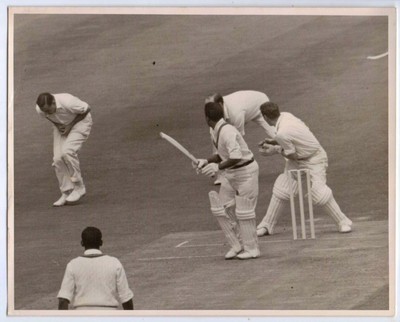
He and Cowdrey had to withstand some fierce bowling from Hall, who often
pitched short and struck the batsmen on the body and fingers.
Eventually Cowdrey received such a blow that a bone just above the left
wrist was broken and he had to retire, having shown his best form of the
series and helping to carry the score to 72.
Close took his place and the England fight back continued, Barrington
hitting Gibbs over mid-wicket for two sixes in an over. Bad light
handicapped the batsmen, and there were two stoppages before the game
was given up for the day at 4.45 p.m. with England 116 for three,
needing another 118.
To add to the tenseness of the situation, rain and poor light delayed
the resumption next day until 2.20 p.m. Hall and Griffith, bowling at
their best on a pitch which had remained lively throughout the match,
made the batsmen fight desperately for every run. Barrington added only
five in 55 minutes, and the first hour brought no more than 18 runs.
Close and Parks took the score to 158, and Titmus also fought well. At
tea, it was still anyone's game with England 171 for five, Cowdrey
injured and 63 needed in 85 minutes. With West Indies averaging only 14
overs an hour, this was a harder task than it looked on paper.
The game moved back in West Indies' favour when Titmus and Trueman fell
to successive balls. Close, who had defended with rare courage despite
being hit often on the body and finishing with a mass of bruises,
decided the time had come to change his methods.
He began moving down the pitch to Hall and Griffith to upset their
length. He succeeded for a time, but eventually he just touched the ball
when trying a big swing and was caught at the wicket. Worrell said
afterwards that while not wishing to detract from a very fine innings,
he thought Close's changed tactics were wrong. Others paid high tribute
to what they termed a magnificent and courageous innings which lasted
three hours, 50 minutes. He made 70, easily his highest score for
England.
Shackleton joined Allen with 19 minutes left and 15 runs required. They
fell further behind the clock and when Hall began his last dramatic over
eight were needed. Singles came off the second and third balls, but
Shackleton was run out off the fourth when Worrell raced from short leg
with the ball and beat the batsman to the bowler's end.
That meant Cowdrey had to come in with two balls left and six wanted. He
did not have to face a ball, Allen playing out the last two. If he had
to shape up, Cowdrey intended to turn round and bat left-handed to
protect his left arm.
Hall, in particular, and Griffith, showed remarkable stamina. Hall
bowled throughout the three hours and 20 minutes that play was in
progress on the last day, never losing his speed and always being
menacing. He took four for 93 off 40 overs in the innings. Griffith
bowled all but five overs on the last day.
The game which attracted 110,287 paying spectators and approximately
125,000 all told, gave cricket a fine boost which was reflected
immediately in improved bookings for the third Test at Edgbaston. The
receipts were £56,300, not far short of the record for any match. Those
who saw it, and the millions who followed the game's progress over
television and radio, were kept in a constant state of excitement. It
was a game to remember.

Comments
Post a Comment